
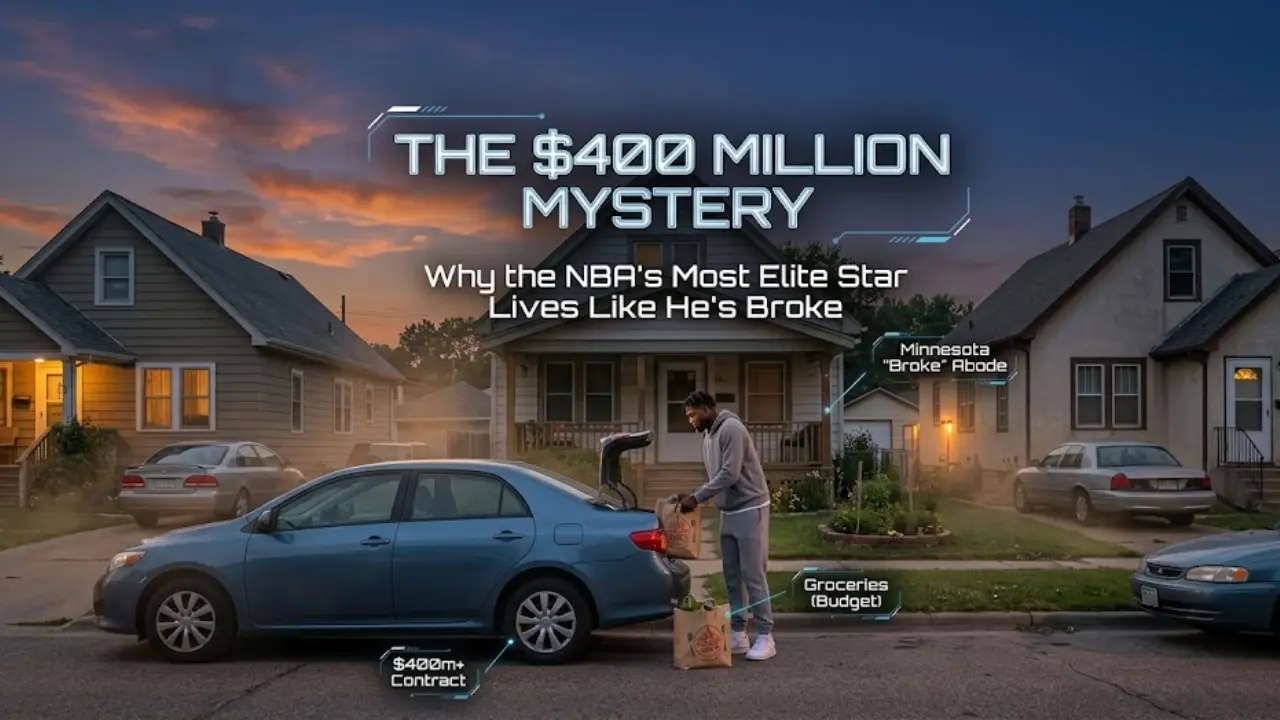
The Quiet Rebel of the NBA Runway
The modern NBA arena tunnel has evolved into a postmodern catwalk. Before the first whistle, players parade through these concrete corridors draped in custom-tailored silks and million-dollar timepieces, their every step choreographed to capture the digital gaze of millions. In this ecosystem, wealth is a loud, performative tool used to signal status and command attention. Yet, Kawhi Leonard remains the NBA’s Great Ghost. Dressed in nondescript sweats with an unreadable expression, Leonard treats his public identity as a tax he simply refuses to pay.
There is a profound, almost jarring curiosity in his silhouette. Why would a man operating in a financial stratosphere—a player whose career earnings are projected to hit $426 million by 2027—choose to live with the unassuming profile of a suburban dad? Leonard’s deliberate invisibility is not born of a lack of imagination. It is a psychological masterstroke. He is a man who understands that in the attention economy, silence is the ultimate luxury. He isn’t just being modest; he is using his hundreds of millions to buy the only two things more valuable than fame: absolute privacy and a fortress of the mind.
The 1997 Chevy Tahoe: A $1,500 Car in a $50 Million Garage
The most enduring symbol of Leonard’s internal logic is parked in his garage. While his contemporaries curate fleets of Italian supercars, Leonard famously clings to a 1997 Chevrolet Tahoe. Nicknamed “the gas guzzler,” this high school relic possesses a top speed that barely grazes 170 kilometers per hour and a market value of perhaps $1,500. Even as his annual salary surged to $50.8 million, Leonard saw no reason to retire the machine.
“It still runs fine and more importantly I’ve already paid it off.”
This preference for utility over flair is a consistent theme. In 2016, as his stardom reached its zenith, he “upgraded” to a $25,000 Subaru Forester, chosen specifically because he was concerned about driving something that might “rattle and groan” too loudly. While he occasionally indulges in high-end machinery—including an air-cooled Porsche 911 (a $80,000 “self-gift”) and a $400,000 bespoke Rolls-Royce Cullinan—the Tahoe remains his primary avatar. To Leonard, a vehicle is judged by its ability to complete a task, not the status it projects to the person in the next lane.
The $40 Million “Fortress” Strategy: Buying the Right to Disappear
While Leonard is parsimonious with his transport, he is expansive with his environment. His real estate portfolio, valued at over $40 million, is a testament to the “fortress strategy.” This includes a $13.3 million complex in Rancho Santa Fe spanning over 1,200 square meters and a $17 million, 1,100-square-meter sanctuary in the Pacific Palisades. These are not residences designed for the “beautiful chaotic montage” of celebrity parties; they are secluded world-states.
The strategy is tactical. Leonard pours wealth into these estates—complete with custom dry saunas and infinity pools—specifically so he never has to leave them. By internalizing his world, he eliminates the friction of public scrutiny. Even his urban movements are calculated; in 2024, he listed his $6.7 million Ritz Carlton penthouse for $6.5 million, a strategic move to reposition his base of operations closer to the Clippers’ new Intuit Dome.
Therefore these real estate fortresses are how he buys out his own privacy.
The “Digitally Bankrupt” Icon: Rejecting the Attention Economy
In an era where digital engagement is a prerequisite for stardom, Leonard remains content to be “digitally bankrupt.” His social media presence resembles a collection of empty rooms—quiet, untouched, and indifferent to the noise. He has no interest in the “yacht selfies” or the “gold leaf steaks” that define the modern influencer athlete.
His private life with partner Kishele Shipley and their children is guarded with a level of military precision that makes him a true global outlier. When he does surface in the public consciousness, it is often via moments of surreal simplicity, such as the viral photo of him standing on a sidewalk holding a coconut. By refusing to participate in the attention economy, Leonard protects his mental bandwidth. He has the power to buy the entire dealership, but he lacks the need for our validation.
The New Balance Pivot: Choosing Respect Over Legacy
Leonard’s business decisions are marked by a similar brand of independent calculation. In 2018, he stunned the industry by walking away from a $22 million extension with Jordan Brand. It was a move that prioritized “respect” over guaranteed legacy. He pivoted to New Balance, accepting a deal worth roughly $5 to $10 million annually—a significant short-term financial sacrifice.
However, the trade-off was “number one star status.” By becoming the architect of a brand’s revival rather than a secondary figure in a legacy roster, Leonard achieved a level of autonomy rarely seen in sports endorsements. It was a masterclass in leverage: trading the comfort of an established machine for the control of his own narrative. With a net worth currently estimated at $160 million and total career earnings destined to eclipse $426 million, Leonard has proven that he can out-earn the system while refusing to play by its social rules.
The Origin of the “Robot”: A Philosophy Forged in Tragedy
The public often labels Leonard “The Robot” for his stoic detachment, but this emotional self-preservation has a somber origin. In 2008, his father was murdered at the family’s car wash in Compton—an environment where flashy displays of wealth often invited unwanted trouble. This tragedy stripped away the trivialities of teenage life, teaching a young Leonard that fame and vanity can vanish in a heartbeat.
The tragedy stripped away the trivialities of teenage life, leaving behind a young man who realized that vanity and fame can vanish in a heartbeat.
What the public perceives as “emotional distance” is actually a high-level tool for professional discipline. His silence is not an absence of feeling, but a fortress designed to protect his concentration. By minimizing his role as a public figure, he ensures that the only noise he makes is on the court. His history created a lifelong philosophy: work in silence, protect the family, and ignore the trivialities of the crowd.
Redefining Wealth as Absolute Freedom
Kawhi Leonard’s story forces us to interrogate what it actually means to be wealthy. In a world obsessed with accumulation and the desperate need to be seen, Leonard suggests that true wealth is the absolute “independence from expectations.”
For Leonard, money is not a tool to make people look at him; it is the currency he uses to ensure that they don’t have to. He remains the ultimate rebel of the NBA not by breaking its rules, but by refusing to be a public commodity. He is a man who can buy the dealership yet chooses the Tahoe—living quietly, freely, and entirely on his own terms. In the end, he has achieved the rarest form of success: he has the fame, he has the $400 million, and yet, he still has himself.

Sam, a dedicated blogger, has immersed himself in the world of content creation for the past five years. His journey reflects a profound passion for storytelling and insightful commentary. Beyond the digital realm, Sam is a devoted NBA enthusiast, seamlessly blending his love for sports with his writing pursuits.