
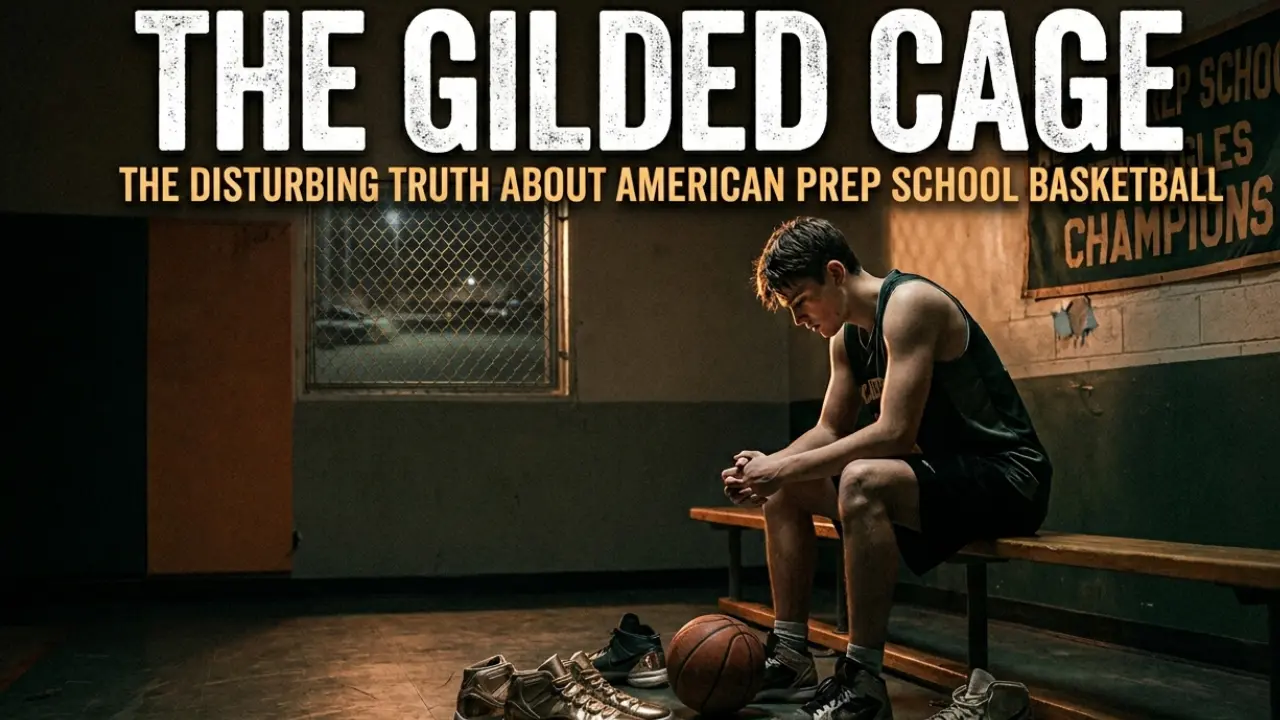
While the bright lights of the NBA and the prestige of NCAA Division I basketball are well-documented, there is a parallel universe fueling these dreams: American Prep School Basketball. On the surface, it looks like a golden ticket. Elite campuses, specialized training, and a fast track to a scholarship. But if you peel back the layers of the “prep school” label, you find a system that is often more about profit and talent-farming than it is about education or the well-being of young athletes.
The Rise of the “Basketball Factory”
Traditionally, a “prep school” meant an elite boarding school like Exeter or Andover—places where students wore blazers and focused on Ivy League admissions. While those schools still exist and play sports, the last two decades have seen the rise of a different beast: The Basketball Factory.
These are often “pop-up” institutions or small private schools that have essentially handed their entire brand over to a basketball program. Their primary goal isn’t to produce Rhodes Scholars; it’s to produce five-star recruits. In many cases, these schools exist solely to bypass the transfer and eligibility rules of traditional public high school athletic associations.
The Recruitment Trap
For a talented 15-year-old in a struggling neighborhood, a recruiter from a top-tier prep school sounds like a savior. They offer:
Free tuition (often through “scholarships” that are loosely defined).
National exposure on major networks.
The chance to play against the best competition in the country.
However, the “disturbing truth” begins with the promise. Many of these players are uprooted from their families, moved across the country, and placed in living situations that are far from the luxury promised in the brochures.
The Academic Mirage
The biggest casualty in the prep school arms race is usually education. Because many of these schools are private and sometimes lack oversight from state boards of education, the quality of schooling can be questionable.
Credit Recovery and “Paper” Classes
There have been numerous scandals involving prep schools that use “online” curriculums or “credit recovery” programs that are essentially shams. The goal is simple: keep the player eligible for the NCAA.
The Risk: If the NCAA Clearinghouse decides a school’s curriculum isn’t rigorous enough, they can invalidate a player’s credits.
The Result: A student-athlete who spent four years focusing on basketball suddenly finds out their high school diploma is worthless, and their dream of a college scholarship is dead.
The “Reclassifying” Trend
In the prep world, it is common for players to “reclassify”—essentially repeating a grade to become older, stronger, and more dominant against younger competition. While this can help with recruitment, it effectively treats a child’s education as a secondary thought to their physical development.
The “Non-Scholastic” Wild West
Unlike public high schools, which are governed by strict state associations (like the UIL in Texas or the CIF in California), many elite prep schools play in “independent” leagues. This means there is no central authority to monitor:
Coach Qualifications: Anyone can call themselves a “coach” or “head of basketball operations.”
Player Safety: Medical staff and trainers are not always required to be on-site.
Financial Transparency: Many of these schools are funded by shadowy boosters or apparel companies (Nike, Adidas, Under Armour) who view these kids as walking billboards.
The Professionalization of Children
We are increasingly treating 14- and 15-year-olds like professional assets. When a prep school recruits a kid, they aren’t just looking for a point guard; they are looking for a return on investment.
The Pressure Cooker
In a traditional high school, if a kid has a bad game, they still go to lunch with their friends the next day. In the elite prep world, your spot on the roster—and your bed in the dorm—is often tied to performance. If a “better” player comes along mid-season, the original player might be “encouraged” to transfer. This creates an environment of extreme anxiety where a teenager’s entire livelihood feels tied to their jump shot.
The Housing Reality
While top-tier “basketball academies” have nice facilities, the lower-tier prep schools often house players in cramped apartments or houses with little to no adult supervision. There have been reports of “coaches” acting as landlords, using the players’ housing as leverage to keep them under their thumb.
The Apparel War
It is no secret that major shoe brands pour millions into grassroots basketball. Prep schools are the front lines of this war. By “sponsoring” a school, a brand ensures that the next LeBron James is wearing their sneakers from the age of 14.
This creates a conflict of interest. Is the coach making decisions based on what’s best for the kid, or what’s best for the brand paying for the team’s travel? When the priority is “marketing,” the human element of coaching—mentorship, character building, and emotional support—often falls by the wayside.
The “After” Problem: What Happens When the Ball Stops Bouncing?
The statistical reality is harsh. Only about 0.03% of high school players make it to the NBA. Even the percentage of players who get a full-ride Division I scholarship is incredibly small.
When a kid goes to a “basketball factory” and doesn’t make it to the pros, they are often left with:
No backup plan.
An inferior education.
A sense of identity that is entirely tied to a sport they can no longer play at a high level.
The system is designed to celebrate the 1% who succeed, while the 99% who are chewed up and spat out are forgotten. These “forgotten” players often return to their hometowns years behind their peers academically and socially.
Is Change Possible?
Not all prep schools are “factories.” Many provide legitimate opportunities for kids to escape dangerous environments and get a world-class education. However, the lack of regulation in the “independent” basketball circuit makes it easy for bad actors to operate.
To fix the system, we need:
NCAA Oversight: Stricter vetting of “independent” high school curriculums.
Parental Awareness: Families need to look past the flashy uniforms and ask to see the school’s accreditation and graduation rates.
Holistic Coaching: Valuing the player as a person, not just a “prospect.”
Summary Table: Public vs. Prep Factories
| Feature | Public High School | Prep “Factory” |
| Governance | State Athletic Association | Independent / Minimal |
| Primary Goal | Education & Community | Recruitment & Exposure |
| Recruitment | Geographic / Zoning | National / International |
| Financial Support | Taxpayer Funded | Boosters / Apparel Brands |
| Academic Focus | State Standards | Eligibility-focused |
The “Disturbing Truth” isn’t that basketball is being played at a high level; it’s that we’ve allowed a multi-million dollar industry to be built on the backs of minors with almost no safety net. When we treat children like products, we shouldn’t be surprised when they end up broken.
The prep school circuit will continue to produce stars, but until we prioritize the “student” over the “athlete,” the trail of broken dreams will continue to grow.

Sam, a dedicated blogger, has immersed himself in the world of content creation for the past five years. His journey reflects a profound passion for storytelling and insightful commentary. Beyond the digital realm, Sam is a devoted NBA enthusiast, seamlessly blending his love for sports with his writing pursuits.