
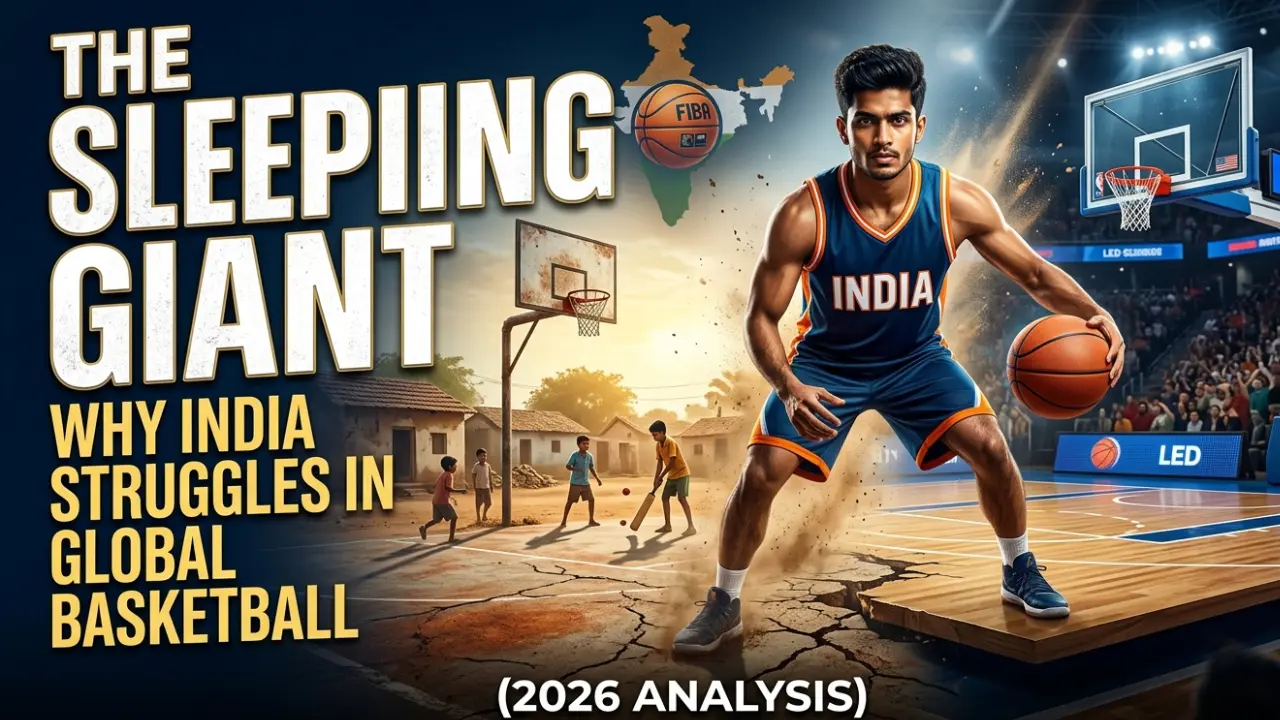
Despite a population exceeding 1.4 billion and a rich history as a founding member of FIBA Asia, India’s basketball trajectory has historically been a story of “what could have been.” As of March 2026, while countries like Japan and South Sudan have made meteoric rises, the Indian Cagers (the national team) remain ranked 76th globally.
To understand this stagnation, we must look beyond the scoreboard and analyze the systemic, cultural, and structural bottlenecks that have hindered the sport’s growth in the subcontinent.
The Socio-Economic “Cricket Hegemony”
The most significant barrier is the absolute dominance of cricket. In India, sports funding and media real estate are a zero-sum game, and cricket currently holds the lion’s share.
Monopolized Sponsorships: Over 80% of private sports investment in India is directed toward cricket. For basketball, this leads to a “starvation cycle” where the lack of funds results in poor marketing, which in turn leads to low viewership and fewer sponsors.
The Talent Drain: Many young athletes with the height and wingspan ideal for basketball are often funneled into fast bowling or specialized roles in cricket because the IPL (Indian Premier League) offers a guaranteed multi-million rupee career path that basketball currently cannot match.
Infrastructure Deficit and “Concrete Burnout”
Basketball is a high-specification sport requiring precise surfaces. In India, the disparity between urban play and international standards is vast.
The Indoor Court Gap: Most Indian “ballers” grow up playing on outdoor concrete or asphalt courts. International competitions are held on FIBA-standard wooden floors. The transition is not just aesthetic; it affects shooting mechanics, joint health, and the speed of the game.
Safety and Maintenance: As highlighted in 2026 infrastructure audits, many public courts suffer from “rim-wear” and rusted poles. Without AMC (Annual Maintenance Contracts) and professional upkeep, these facilities become safety hazards rather than training grounds.
The “Missing Middle”: Lack of a Professional Pipeline
Until very recently, a basketball player’s career path in India ended at the “Sports Quota” level—securing a job in the Railways, Customs, or Police.
Absence of a Sustainable Pro League: While the India Basketball League (IBL) is slated for a major relaunch in late 2026, the historical lack of a consistent league has prevented players from becoming “full-time professionals.” Without 40–50 high-intensity games a year, Indian players lack the “game IQ” found in European or American counterparts.
Coaching Methodology: Historically, Indian coaching focused on “tall-man” tactics—finding the biggest kid and putting them under the rim. Modern basketball is positionless, requiring three-point shooting and high-level ball handling from all five players.
Grassroots and Talent Identification
The Residential Model: The launch of the High-Performance Centre (HPC) in Bengaluru (November 2025) marked a shift toward a “phygital” training approach—merging physical drills with AI-powered biomechanics and wearable tech.
Talent Scouring: Organizations like the Basketball Federation of India (BFI) are now moving away from accidental discovery to active “Talent ID” programs in schools across Ludhiana, Chennai, and Mumbai.
Comparative Data: The Growth Gap (2025-2026)
| Factor | Basketball (India) | Global Benchmark (Top 20) |
| Professional League Matches | 10–15 per year | 60–82 per year |
| Indoor Facilities (Per 1M People) | < 0.5 | 15–20 |
| Full-time Coaches (FIBA Level 3) | ~150 | 5,000+ |
| Average Fan Engagement | 4% of sports viewers | 25%+ (e.g., Philippines, USA) |
The “Role Model” Vacuum and Cultural Identity
Sports growth is often fueled by a “Hero Narrative.” India’s basketball history is littered with promising starts that lacked follow-through.
The Satnam Singh Precedent: When Satnam Singh was drafted in 2015, it was expected to be a “Yao Ming moment.” However, due to a lack of foundational support, the momentum fizzled.
Cultural Perception: Basketball is often seen as an “urban, elite” sport in India, unlike wrestling or kabaddi, which have deep rural roots. Bridging this urban-rural divide is essential for expanding the talent pool.
The Rise of 3×3 Basketball
3×3 Basketball,this format is a game-changer for India because:
It requires half the space and infrastructure.
It rewards the high-speed, “street” style of play common in Indian colonies.
The Olympic inclusion of 3×3 has unlocked new government grants under the Khelo India initiative.
Is the “Sleeping Giant” Waking Up?
India isn’t “bad” at basketball due to a lack of athletic potential; it is a victim of institutional inertia. However, the 2026 roadmap—anchored by the Bengaluru High-Performance Centre and the upcoming IBL—suggests a pivot toward a scientific, league-driven ecosystem. If India can convert its “school-level” interest into a “professional-level” career path, the 76th world ranking will soon be a thing of the past.
References:
FIBA World Rankings (Updated March 2026).
BFI National Ranking Policy 2025-26.
Ministry of Youth Affairs & Sports: “Grassroots to Greatness” Report (Feb 2026).
NBA Academy India: Annual Performance Review 2025.

Sam, a dedicated blogger, has immersed himself in the world of content creation for the past five years. His journey reflects a profound passion for storytelling and insightful commentary. Beyond the digital realm, Sam is a devoted NBA enthusiast, seamlessly blending his love for sports with his writing pursuits.