
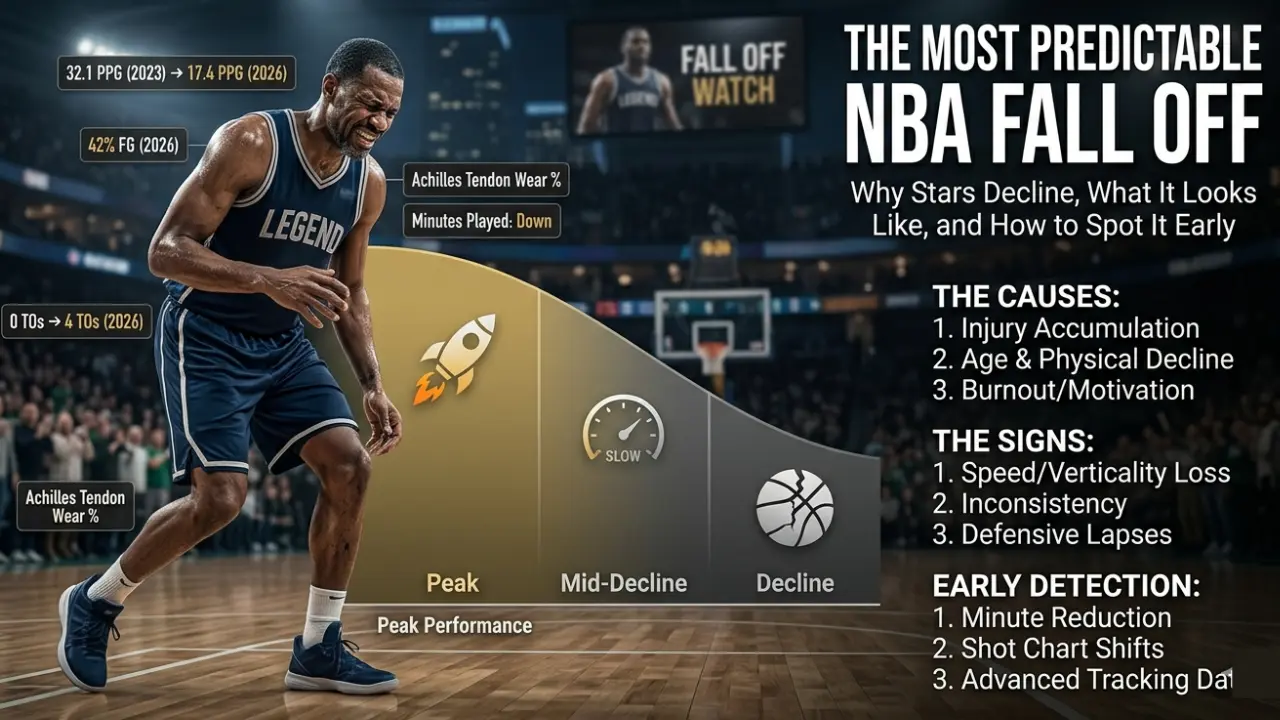
Some NBA career declines feel sudden. Others look inevitable in hindsight. The “most predictable fall off” pattern is usually not about one game, one rumor, or one slump. It is about a predictable combination of injuries, role changes, on-court skill gaps, off-court volatility, and market realities that make it harder for teams to justify big commitments.
This guide breaks down how star declines typically happen, the signs that show up before performance drops, and what fans and analysts can look for when evaluating a player’s trajectory.
What “fall off” really means for an NBA star
A fall off is not just a dip in scoring. It is usually one or more of the following:
- Efficiency erosion: shooting percentages drop because the player’s shot quality declines or shot selection changes.
- Role shrinkage: the player stops initiating offense as often, plays fewer minutes, or is used differently.
- Physical limits: injuries or recovery reduce speed, explosiveness, or endurance.
- Skill mismatch: the player’s best strengths are easier to defend over time.
- Availability problems: missed games change rhythm, conditioning, and team continuity.
- Market and trade friction: salary, contract term, and fit constraints reduce flexibility.
The most predictable versions share a common theme: the warning signs were visible early, but they were often dismissed as “normal adjustment” or “temporary noise.”
The “predictable” fall off framework: 6 drivers
1) Athletic advantage dries up
Many elite stars build their game around speed, verticality, or repeated high-intensity drives. That is hard to sustain indefinitely, especially with:
- heavy minutes
- frequent contact at the rim
- minor injuries that add up
- training limitations due to wear and tear
When the first step and landing mechanics decline, everything changes. Defenders close earlier. Finishing gets harder. The player compensates by taking tougher shots, which can reduce efficiency and strain confidence.
2) The offense becomes easier to defend
Defense adapts. A predictable decline often follows when a player has:
- one primary path (for example, consistently attacking the same advantage)
- limited secondary options (few reliable mid-range or pull-up tools)
- declining ability to create space
In those cases, opponents do not need to “shut the star down.” They just need to remove the easiest scoring route and force uncomfortable, lower-percentage attempts.
3) Injury and availability compound the problem
Injuries are rarely isolated events. They can cause a cycle:
- miss time
- return early
- lose rhythm
- re-aggravate
- play more cautiously to protect the body
Even when a player remains talented, fewer consecutive games usually leads to slower reads, less fluid movement, and weaker finishing. That can become self-reinforcing across a season.
4) Role and coaching fit shift
Teams evolve. A “predictable fall off” may start after a coaching change, a roster overhaul, or a shift in offensive philosophy. Common examples:
- the star is asked to space the floor more but cannot shoot reliably
- ball-dominant usage increases, but the rest of the roster is not built to complement it
- the team adds defensive schemes that punish one-dimensional routes
When the star’s strengths no longer align with the system, production often drops first, and confidence follows.
5) Off-court volatility affects on-court clarity
NBA careers are influenced by more than basketball. Conduct issues, suspension risk, media pressure, or internal team conflict can create a stressful environment that impacts:
- practice focus
- team chemistry
- on-court decision-making
- how coaches manage the player
When the team feels uncertainty around availability or discipline, usage patterns can become inconsistent, which makes performance harder to stabilize.
6) Contract reality changes team incentives
Even when a player declines gradually, the “market” can harden. High salary plus limited flexibility can make teams reluctant to:
- fully rebuild around the player
- take on the contract without immediate performance certainty
- pay to maintain a role that no longer matches the player’s skill set
This is where the fall off becomes “predictable” in hindsight: the player’s decline collides with financial constraints, limiting options for both the player and the organization.
Early warning signs to watch for (before the slump becomes a fall off)
Fans often notice declines when scoring drops. But the best early signals are usually visible earlier in the season or even in the prior year.
- Fewer rim attempts or lower first-step effectiveness
- More drives that end in contact but with worse finishing
- Higher turnover rate without a clear matchup reason
- Less time in primary playmaking situations
- Visible changes to shot selection (too many contested jumpers, fewer floaters)
- Frequent injury-related “return management” (minutes restrictions, cautious play)
- Discipline issues (techs, altercations, suspension risk)
If multiple signals stack up together, the decline is more likely to accelerate than to reverse.
How teams and analysts evaluate whether a decline is reversible
Not every fall off is permanent. The key question is whether the player’s game can evolve alongside physical changes and scheme adjustments.
Signs the decline might be reversible
- Improving efficiency relative to shot quality (taking better shots, not just fewer)
- Credible new skills (mid-range accuracy, better pull-up mechanics, smarter shot selection)
- Stabilized availability (more consecutive games, fewer setbacks)
- Clear role fit where usage matches the player’s strengths
Signs it is likely structural
- Repeated inability to adjust when the main scoring path gets defended
- Persistent efficiency decline despite role or coaching changes
- Chronic injury limitations that restrict movement during peak moments
- Disconnect with team culture that leads to inconsistent behavior or trust
Common misconceptions about NBA fall offs
Misconception 1: “It is just a bad season.”
A predictable fall off usually begins with patterns, not one anomaly. Look for consistent trends across advanced metrics, role usage, and availability.
Misconception 2: “Decline equals age.”
Age matters, but decline often tracks physical wear, injury history, and how the player adapts. Some players lose athleticism and upgrade their shooting or decision-making. Others cannot.
Misconception 3: “Scoring is all that matters.”
Stars can score less because their value shifts to playmaking, defense, or spacing. The problem starts when both scoring and impact metrics decline due to limitations in driving, finishing, or creation.
Misconception 4: “Contract size guarantees decline.”
Contracts do not cause performance. But they do affect risk tolerance, roster planning, and how quickly teams can pivot away from a player.
What fans can do: a simple checklist to spot the pattern
Use this checklist when evaluating whether a star is on a predictable decline path:
- Availability trend: Are missed games increasing or do injuries keep resurfacing?
- Creation trend: Do touches and playmaking duties increase, decrease, or fluctuate wildly?
- Rim pressure: Are attempts at the basket falling or becoming less effective?
- Shot quality: Do percentages track below expected shot quality or only during certain stretches?
- Adaptation: Has the player added skills that offset lost athleticism?
- Discipline and stability: Are conduct issues or team conflict creating disruption?
- Team fit: Does coaching and roster design match the player’s strengths?
When several items worsen at the same time, the fall off is rarely an accident.
The most predictable NBA fall offs are usually the result of stacked factors: physical decline, defensive adaptation, injury and availability issues, role and system mismatches, off-court volatility, and contract constraints. The earlier you spot those interacting signals, the less surprising the decline feels later.
If you want to evaluate a player realistically, focus less on one bad stretch and more on whether the game is adapting, whether health is stabilizing, and whether the role fits what the player can still do at an elite level.

Sam, a dedicated blogger, has immersed himself in the world of content creation for the past five years. His journey reflects a profound passion for storytelling and insightful commentary. Beyond the digital realm, Sam is a devoted NBA enthusiast, seamlessly blending his love for sports with his writing pursuits.