
Know Your League Settings and Goals
Before you dive into drafting or making waiver moves, the first step is to know exactly how your league works. This might sound obvious, but many beginners get tripped up by not confirming their league’s scoring system, roster rules, or playoff setup. Let’s break it down so you can build a winning strategy from the ground up.
How to Tell If Your League Is Points, 8-Cat, or 9-Cat—and Why It Matters
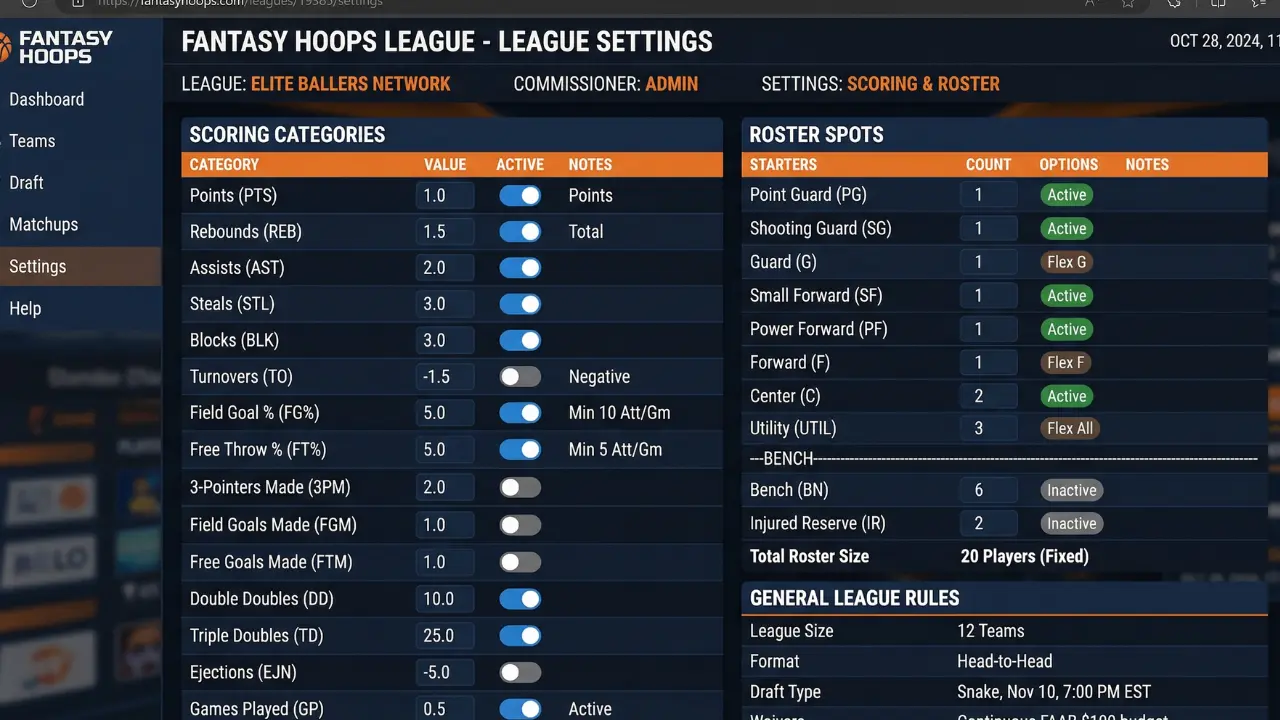
Quick check: Open your league settings and find the scoring panel. You’ll see either:
- A single total points number (that’s a points league), or
- A list of categories like PTS (points), REB (rebounds), AST (assists), STL (steals), BLK (blocks), 3PM (3-pointers made), FG% (field goal percentage), FT% (free throw percentage), and TO (turnovers).
If you see categories, count them to know if it’s 8 or 9 categories. Don’t guess—confirm if percentages and turnovers are included because they change your draft and roster strategy.
What changes with each?
| League Type | Draft Strategy Summary |
|---|---|
| Points League | Focus on players who rack up raw fantasy points. High-usage scorers and consistent minutes win here. Efficiency (like shooting %) matters less. |
| 8/9-Cat League | Balance is key. You want players who contribute across multiple categories or you can “punt” (ignore) one category strategically. Watch FG% and FT% closely, and be careful with turnovers if they count negatively. |
Pro tip: If you’re new, just draft according to your league’s scoring. For category leagues, pick balanced players early. For points leagues, go for volume scorers. Always double-check if FT% or TO are counted before punting or targeting specialists.
Which Settings Matter Most—and How They Affect Your Weekly Plan
Here are the key settings to know and how they change your approach:
- Roster spots (starters vs bench): More bench spots mean you can stash risky players and take longer-term gambles. Thin benches force you to pick safer, high-minute players and rely on streaming (picking up players for short-term boosts).
- IL/IR slots: These let you stash injured players without losing a roster spot. If your league has IR slots, you can hold onto injured stars confidently. If not, be stingier with your stashes.
- Daily vs weekly lineups: Daily lineups let you tweak your roster every day—great for playing hot players and exploiting matchups. Weekly lineups lock your roster for the whole week, so you need to plan ahead and stagger your players to cover injuries or rest days.
- Playoff weeks: Know which weeks count as playoffs in your league. This helps you decide when to stash players with good schedules during those weeks.
How this affects your weekly moves:
- Thin bench + weekly locks = stick to players with guaranteed minutes, fewer risky bench stashes.
- IL/IR slots = stash injured stars without worry.
- Daily leagues = check lineups late, stream players on back-to-back games.
- Weekly leagues = hold a few streaming spots and set lineups based on which teams play the most games that week.
Setting Realistic Season Goals and Tracking Your Progress
It’s important to have a clear goal so you know if you’re on track.
- In a 12-team league, a solid goal is to make the playoffs (usually top 6). Aiming for a top-3 finish is tougher but doable if you draft well or trade smart.
- Start by aiming for the lower half of playoff spots, then push for higher as the season goes on.
How to track progress weekly:
- Check your win-loss record and winning percentage.
- In category leagues, track how many categories you win each week.
- Use simple power rankings: consider injuries, minutes, upcoming schedules, and your FAAB (free agent acquisition budget) balance.
- Set milestones at midseason and two weeks before playoffs. If you’re behind, prioritize trades or waiver moves to fix weak spots.
Example: If you’re winning about 50–60% of your matchups and staying in the top half of weekly category wins or points, you’re on the right path.
Draft and Roster Construction 101
Building your NBA fantasy roster can feel like a puzzle, but once you get the hang of the basics, it’s a lot less scary. Let’s break down the key parts: whether to go balanced or punt a category, how to spread out your players by position, and how to use ADP (Average Draft Position) without getting lost.
Balanced Build vs. Punting: What’s Best for You?
Balanced build means you try to do a little bit of everything. It’s the safest way to start because it keeps your options open each week and makes waiver moves simpler. For beginners, this is usually the best path.
Punting means you intentionally ignore one or two categories to focus on winning others. It’s a more advanced strategy and can pay off if you know what you’re doing.
Here are the easiest punts for beginners:
- Free Throw Percentage (FT%) Punt: You pick players who score a lot but aren’t great at free throws. This can tank your FT% but boost points and assists. Just be careful—if you can’t balance it out, you might lose too many FT% points.
- Blocks Punt: Blocks are rare and unpredictable. If you don’t draft big rim protectors, accept losing blocks but aim to win other categories.
- Turnovers Punt: This one’s tricky. It means you’re okay with players who turn the ball over a lot because they bring other stats. Not recommended for beginners.
Tip: If you’re new, stick to balanced builds your first season. Only punt if you have a clear plan and understand the risks.
How Many Guards, Wings, and Bigs Should You Draft?
In a 12-team league, here’s a good target for your roster:
| Position | Number of Players |
|---|---|
| Guards (PG/SG) | 4–6 |
| Wings (SF/SF-PF) | 4–5 |
| Bigs (PF/C) | 3–5 |
Adjust these numbers based on your league’s starting lineup rules and look for players who can play multiple positions. Flexibility helps when injuries or rest days hit.
Handling scarce stats like assists, blocks, and steals:
- Assists: Draft guards who handle the ball a lot, even if they don’t score tons. They’ll rack up assists by running the offense.
- Blocks: Grab at least one top-tier big man and one solid mid-tier rim protector early. Blocks can be volatile, so don’t expect backups to help much here.
- Steals: Look for quick, active guards and wings who play aggressive defense.
Quick checklist:
- Identify 2–4 “category anchors” who consistently deliver in rare stats.
- Fill the rest of your roster with players who contribute across multiple categories.
- Use weekly streaming (picking up players from waivers) to cover fluctuations in steals and blocks.
Using ADP: When to Follow, Reach, or Pass
ADP (Average Draft Position) shows where players usually get picked. Think of it as a guide, not a rulebook.
When to follow ADP:
- You need steady production and the player fits your roster spot.
- There’s a run on a position, and you don’t want to miss out on depth.
When it’s okay to reach (draft earlier than ADP):
- You have a specific need (like a scarce stat or position).
- The player has a clear role increase or more minutes coming.
- Keep reaches small—1 or 2 rounds max.
When to pass on injured or rest players:
- Early rounds: Avoid big gambles on players with uncertain return dates.
- Late rounds: It’s fine to stash injured stars if you have bench or IR spots.
Rule of thumb: Don’t reach more than 2–3 rounds above ADP unless you have strong reasons. Early on, prioritize stability; later, look for upside.
With these basics, you’re ready to draft smarter and build a roster that can compete every week. Remember, fantasy is a marathon, not a sprint—start solid, adjust as you go, and have fun!
Lineup Management and Streaming
Managing your lineup well and knowing when to stream players can be the difference between losing every week and finally starting to win. Let’s break down how to maximize your games played, keep some streaming spots open, and set your weekly lineups without overthinking it.
Maximize Games Played Each Week
The key to winning fantasy is getting as many quality games from your roster as possible. Here’s a simple way to do that:
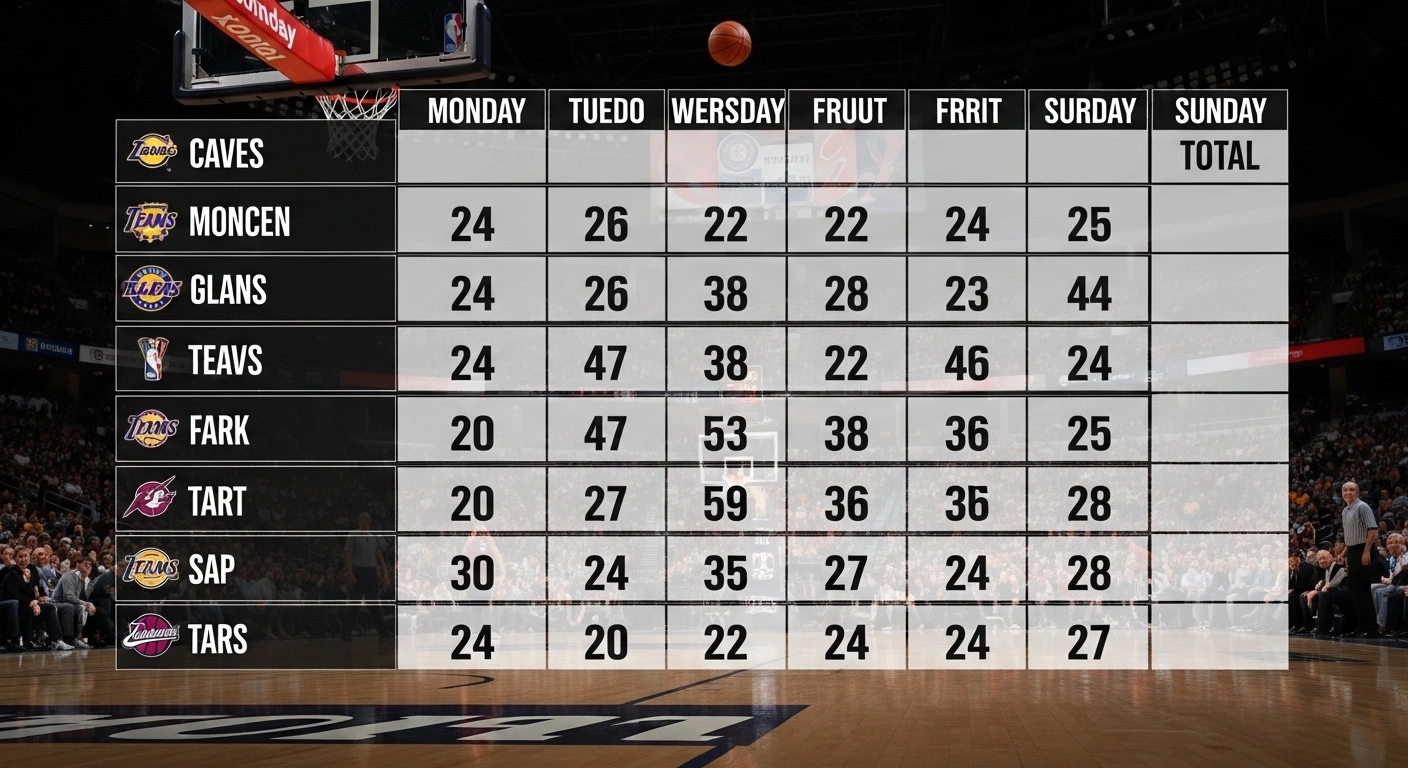
- Check the weekly schedule matrix. Many fantasy sites show how many games each NBA team plays that week. Target players on teams with more games.
- Diversify your roster across teams. Don’t load up on just one or two teams. Spreading out helps avoid weeks where your players have fewer games.
- Target players who play through back-to-backs (B2Bs). Look for starters who don’t lose minutes on the second night or get consistent coach trust.
- Use streaming on low-game days. If your starters have fewer games than your opponent’s, add short-term players to fill those gaps.
- Adjust lineups late in the week. In daily leagues, wait for official inactive news before setting lineups. In weekly leagues, set lineups based on who has the most games and known rest patterns.
Bottom line: Aim for roster diversity and use streaming to fill holes on low-game weeks.
Tip: On average, NBA teams play about 3–4 games per week, but some weeks can have 5 or 6. Having players from teams with 5+ games can give you a big edge.
How Many Streaming Spots Should You Keep?
Streaming means adding and dropping players frequently to take advantage of favorable schedules or matchups. But how many spots should you keep open?
- In a 12-team league with weekly locks: Keep 2–4 streaming spots active.
- If your bench is thin or your schedule looks tough, lean toward 3–4 spots.
- If you have a deep bench or daily lineup changes, 1–3 spots usually work.
Choosing streamers based on your needs:
- Identify your weak categories first. For example, if you need steals, pick guards on teams with many games who get steals.
- Consider matchups and pace. Fast-paced opponents mean more points, rebounds, and assists.
- Prioritize players with multiple games that week and a reliable role—avoid those who might get benched suddenly.
- In points leagues, pick players with high projected fantasy points based on minutes and matchups.
Quick filter for streamers:
| Factor | What to Look For |
|---|---|
| Games this week | More games = more chances to score |
| Expected minutes | Starters or key rotation players |
| Opponent pace | Fast-paced teams = more counting stats |
Setting Lineups in Weekly Lock Leagues
Weekly lock leagues can be tricky because you set your lineup once per week. Here’s a simple checklist to hedge against injuries and rest days without going crazy:
- Set a late reminder. Update your lineup close to the lock time but after the last injury report.
- Prioritize reliable minutes. Start players who are almost guaranteed to play over boom-or-bust bench scorers.
- Stagger risky players. If two starters from the same team might rest on a B2B, start the safer one.
- Keep 1–2 bench spots open for streaming. Use these to replace scratched starters last minute.
- Accept small losses. Don’t overhaul your whole roster for one bad night. Use waivers or FAAB (Free Agent Acquisition Budget) to fix recurring issues.
Rule of thumb: Start your safest lineup first. Use bench and streamers to chase upside only when the schedule and matchups clearly favor it.
With these lineup and streaming tips, you’ll stop feeling overwhelmed and start making smart moves that pay off week after week.
Waiver Wire and FAAB Mastery
Navigating the waiver wire and managing your FAAB (Free Agent Acquisition Budget) can feel like a full-time job. But with a few smart habits and clear rules, you’ll stop missing out on breakout players and start making moves that actually win weeks.
Spotting Real Breakouts vs. One-Week Hot Streaks
Not every player lighting it up for a game or two is worth burning your FAAB on. Here’s a quick checklist to help you tell if a player’s breakout is for real:
- Minutes: Look for a steady increase in playing time over 3 to 7 games. Coaches don’t usually give big minutes for just one good night.
- Usage Rate & Shot Attempts: Are they getting the ball more often? A rising usage rate over several games means a bigger role.
- Role Clarity: Has the coach officially named them a starter or primary ball-handler? Injuries to teammates can also open up consistent minutes.
- Efficiency: Hot shooting nights tend to cool off. If their shooting percentages stay steady while attempts rise, that’s a good sign.
- Team Context: Check if injuries or trades are creating lasting opportunities. Also, look at the upcoming schedule to see if minutes will stick.
Pro tip: Wait for a 3–7 game sample showing steady minutes and usage before spending big FAAB or trading. Early on, use small bids to test the waters.
How Much FAAB Should You Spend and When?
Think of your FAAB like a budget for buying players. Spend too much too soon, and you’ll have nothing left when it counts.
| Season Phase | Suggested Bid Range (12-team, $100 budget) | What to Target |
|---|---|---|
| Early Season (Wks 1–4) | $1–6 (1–6% of budget) | Obvious adds, low-risk pickups |
| Midseason (Wks 5–14) | $6–20 | Players with real role changes, breakouts |
| Playoffs (Last 4–6 Wks) | $20–40+ | Players who help in your playoff weeks |
Adjust these based on your league depth:
- Shallow leagues (10 teams): Spend about 25% more early since talent is thinner.
- Deeper leagues (12–14 teams): Conserve early, expect to spend more mid-to-late season, and save a good chunk for playoffs.
Remember: Keep 20–40% of your FAAB for the playoff stretch. Don’t blow it all in week 2!
When to Check Waivers and Build Your Watchlist
Timing is everything. Checking waivers at the right moments helps you snag players before your leaguemates do.
Best times to check:
- Right after games end (injuries often happen during games)
- The morning after (official injury updates and coach comments)
- 90–120 minutes before lineup lock (final inactive lists and scratches)
- After the trade deadline or big rotation changes
Building a watchlist that works:
- Use your fantasy app’s watchlist and turn on notifications.
- Follow reliable NBA beat reporters on Twitter/X for quick injury and rotation news.
- Set alerts for keywords like “out,” “questionable,” or “rest” if your platform allows.
- Keep your list short (8–12 players), prioritizing immediate targets and speculative stashes.
- Update it weekly to stay sharp.
Quick setup: Combine your app’s watchlist + one trusted news feed + a daily post-game check to catch injuries and role changes early.
Mastering these waiver wire and FAAB basics will help you build a confident roster and finally stop losing every week. You’ve got this!
Smart Trades Without Getting Burned
Making trades can feel risky, especially when you’re still learning the ropes. But smart trades are one of the best ways to boost your NBA fantasy team without relying solely on the waiver wire. Here’s how to spot good deals, avoid common pitfalls, and pitch trades that get accepted.
Spotting Buy-Low and Sell-High Candidates
Buy-low means grabbing players who are underperforming now but likely to bounce back. Sell-high means trading away players who are overperforming and probably won’t keep it up.
Look for these signs:
| Buy-Low Signals | Sell-High Signals |
|---|---|
| Low shooting % but steady shot attempts | Shooting % way above career norms |
| Minutes expected to rise (injuries, trades) | Role shrinking soon (starter returns, coach changes) |
| Tough early schedule easing up | Upcoming tough fantasy schedule |
| Strong peripherals (shots, free throws) despite poor results | Short-term hot streaks with likely usage drop |
How to check:
Use a 10-game rolling look at volume (minutes, shot attempts) and efficiency (FG%, 3P%). If volume is steady but efficiency is unusually low, that’s a buy-low. If efficiency is unusually high but volume is steady, that’s a sell-high.
Don’t forget the schedule: Target buy-low players with easier fantasy playoff weeks ahead. Sell-high players who face tough matchups soon.
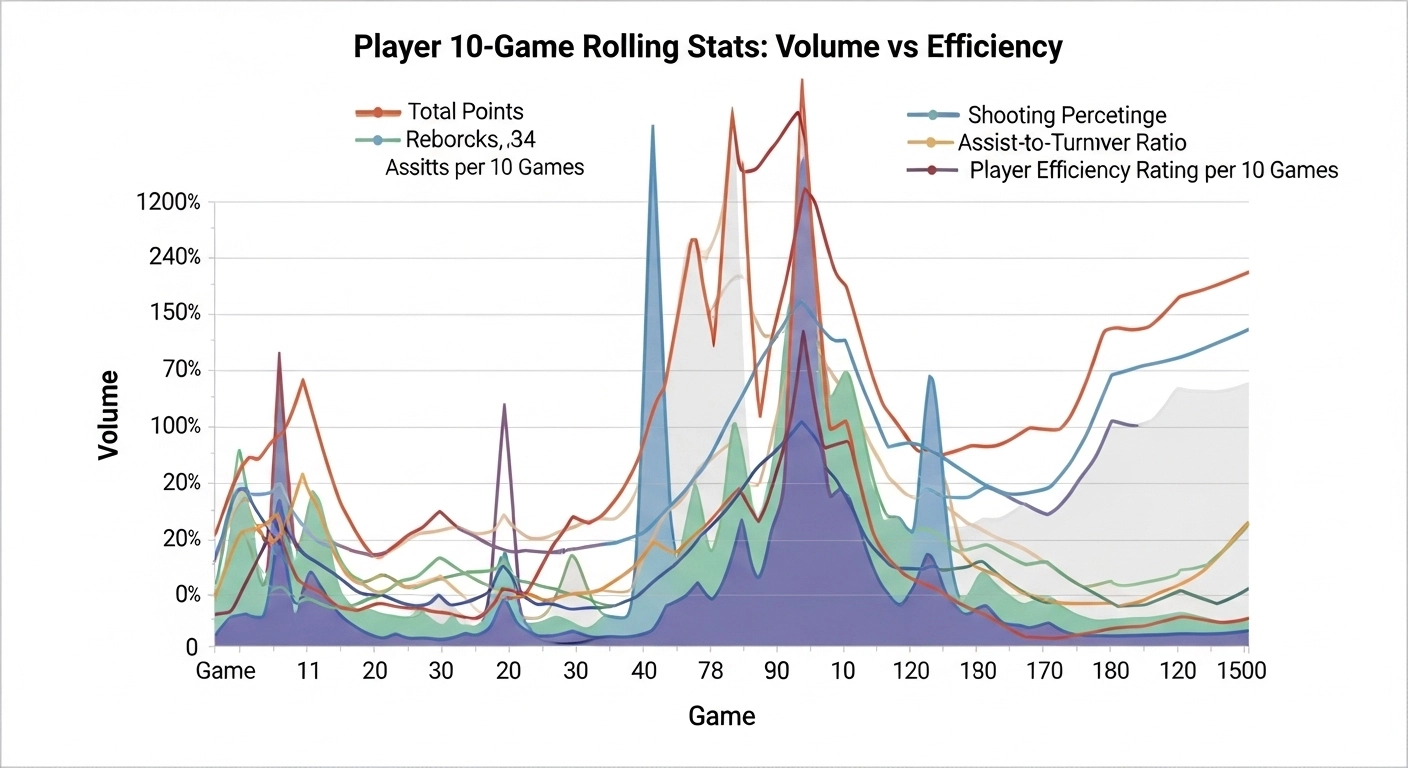
Tip: Players with stable usage but unlucky shooting percentages often bounce back quickly. Don’t be scared to grab them at a discount.
When Is a 2-for-1 Trade Worth It?
Sometimes you want to trade two fringe players for one solid starter. This can free up a roster spot for streaming (picking up players week-to-week) or upgrade a weak category.
Use 2-for-1 trades when:
- You get a clear upgrade in minutes and floor production.
- You can afford to lose depth in marginal players.
- You create a valuable streaming spot for weekly moves.
Avoid trading away categories you already lack:
- Map your team’s strengths and weaknesses before trading.
- Don’t give up your only reliable source of steals, blocks, or assists.
- Only trade from categories where you have multiple players covering the stat.
Example:
Trade two mid-bench wing scorers who don’t help assists or defense for a starting guard who provides assists and steals, plus a streaming spot. This upgrades your team and keeps your categories balanced.
Fair-Trade Etiquette and Pitching Deals
Good trades happen when both sides feel like winners. Here’s how to keep it friendly and get your deals accepted:
- Be transparent: Explain why the trade is fair using clear reasons like category boosts, minutes, or schedule.
- Don’t bait: Avoid sending lowball offers just to see if the other manager complains. It wastes time and goodwill.
- Respect rules: Follow your league’s trade deadlines and don’t pester managers repeatedly.
Explain value clearly:
- Show how the trade helps their weak spots (e.g., “This adds blocks and rebounds where you’re thin.”)
- Use numbers if you can (projected points or recent stats).
Pitch a win-win:
- Look at their team needs and frame the trade as solving their problems too.
- Example pitch: “I need scoring and 3-pointers. This trade gives you a safe big man for blocks and boards, and I get the scoring upside.”
Remember: Trades get done when both sides feel they’re improving. Be polite, clear, and fair.
With these tips, you’ll trade smarter, avoid getting burned, and build a roster that wins more weeks. Keep an eye on stats, schedules, and your team’s category balance — and don’t be afraid to make moves that help both sides.
Playoffs Planning, Injuries, and Common Mistakes
When Should You Start Planning for Fantasy Playoffs?
You want to get ahead of the game here. Start scouting around midseason (weeks 8–10). That’s your sweet spot to lock in players who’ll shine during your league’s playoff weeks. Don’t wait until the last minute — grabbing playoff-targeted stashes 2–3 weeks before your playoff window is key.
Which teams should you target?
Look for teams that:
- Avoid heavy load management (meaning their stars actually play during playoffs).
- Have more games scheduled during your fantasy playoff weeks.
Since NBA teams shuffle rest days and rotations every year, there’s no fixed “best” team. Use a schedule matrix tool (many fantasy sites offer these) to see which teams have the most games during your playoff stretch.
Practical steps:
- Use a schedule tool to find players on teams with high game counts in your playoff weeks.
- Stash players likely to play and who have favorable schedules.
- Save some FAAB (Free Agent Acquisition Budget) dollars for playoff-only pickups when rosters tighten.
Tip: Teams like the Miami Heat or Golden State Warriors often have playoff-heavy schedules and less load management, but always double-check each season’s schedule!
Using IL/IR and Short-Term Stashes Without Clogging Your Bench
Injuries and load management can wreck your roster if you’re not careful. Here’s how to use your Injured List (IL/IR) slots and short-term stashes smartly:
- Prioritize players with a confirmed return date within your league’s IL eligibility window. Don’t stash long-term projects unless you have the bench space and IR slots.
- Use IL/IR slots for players officially on injury lists who’ll miss multiple weeks. This frees up bench spots.
- Limit short-term stashes to 1–2 players with clear near-term catalysts (like a star returning or a teammate’s injury opening minutes).
- If you need to cut someone, drop high-variance players with uncertain roles instead of steady contributors you rely on.
Weekly habit: Review your injured players every week. If a stash hasn’t moved toward returning in 7–10 days, cut them and reallocate your FAAB. Keep your bench flexible!
Common Beginner Mistakes and How to Avoid Them
Here are the top rookie traps and how you can dodge them:
| Mistake | What Happens | How to Fix It |
|---|---|---|
| Chasing raw points in 9-cat | Picks high scorers who kill FG%/FT% or turn the ball over | Balance categories; don’t ignore efficiency and turnovers |
| Ignoring minutes | Drafts talent who barely play, leading to bench issues | Draft for consistent minutes and role early on |
| Dropping steady producers too fast | Overreacts to one bad week | Use a 7–10 game sample before making moves |
| Burning all FAAB early | No budget left for playoff stashes | Budget FAAB across early, mid, and playoff windows |
| Over-punting without a plan | Weak in multiple categories | If you punt, commit to a clear strategy |
| Not tracking schedule/games-played | Loses matchups due to fewer games | Check weekly game counts and diversify teams |
Quick checklist before drops or bids:
- Minutes check
- Usage check
- Schedule check
- Watchlist check
Treat your first few weeks as learning time. Avoid drastic roster surgery unless you have solid evidence.
Remember, fantasy basketball is a marathon, not a sprint. With smart planning, patience, and a little strategy, you’ll stop losing every week and start enjoying those sweet wins. You’ve got this!

Sam, a dedicated blogger, has immersed himself in the world of content creation for the past five years. His journey reflects a profound passion for storytelling and insightful commentary. Beyond the digital realm, Sam is a devoted NBA enthusiast, seamlessly blending his love for sports with his writing pursuits.