
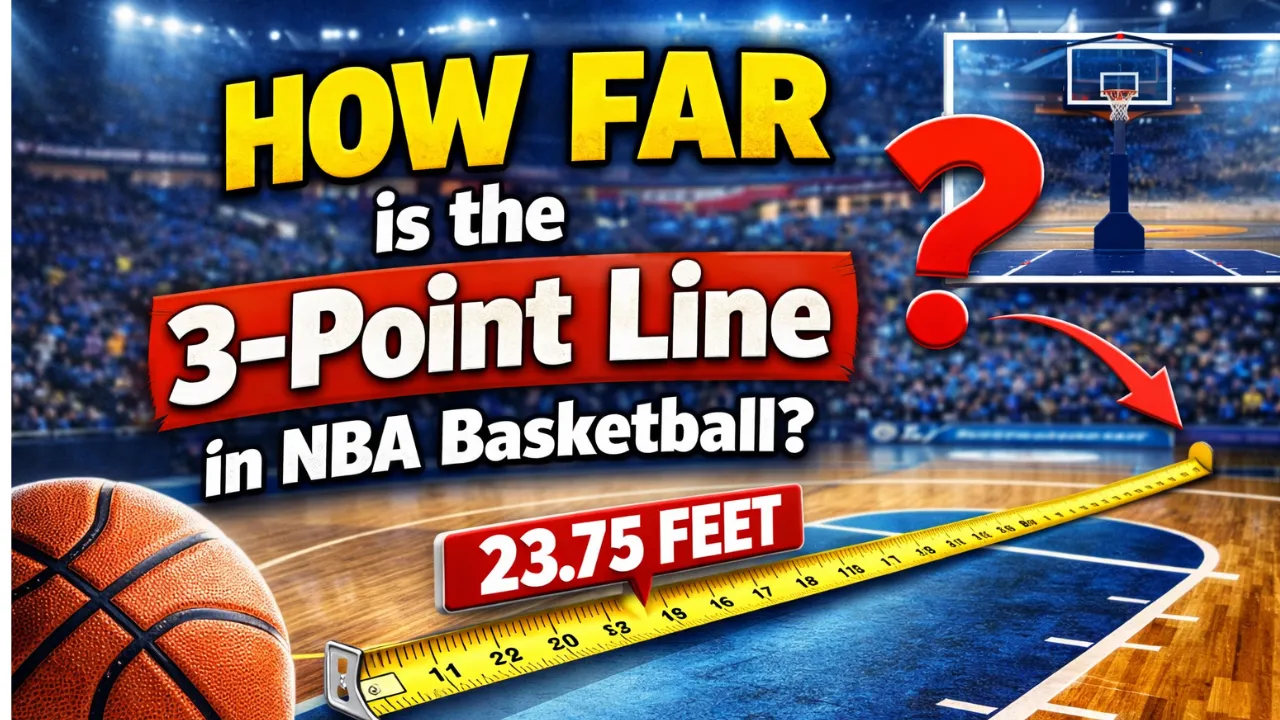
The NBA three-point line sits 23 feet, 9 inches from the basket center at the top of the arc, shortening to 22 feet in the corners along the sidelines. This setup challenges shooters to nail long-range bombs while keeping the court playable near the edges.
Why the Distance Varies
That arc isn’t a perfect circle—NBA rules draw straight lines 3 feet from each sideline, blending into the curve for a uniform challenge. Corners feel “shorter” at 22 feet since they’re parallel to the baseline, letting wing players like Steph Curry heat up from closer spots without hugging the line. No changes hit in 2026; it’s locked since the league reverted from a shorter experiment in the ’90s.
History of the Three-Point Line
Debuted in the ABA during the ’60s, the NBA adopted it in 1979 but ditched it after one season—scoring dipped too low. Back for good in 1986 at today’s distance, it exploded the game; teams now jack threes like candy, with attempts doubling since 2015. Short-lived tweak to 22 feet flat from ’94-’97 aimed to boost offense, but fans hated the “shortened” feel, so they stretched it back.
Comparisons Across Leagues
FIBA and WNBA stick to a uniform 22 feet, 1.75 inches (6.75 meters) everywhere—simpler for global play. NCAA matches that post-2019 move from 20 feet, 9 inches, easing the jump for college stars entering pros. High school lags at 19 feet, 9 inches, prepping kids gradually; Euroleague mirrors FIBA for that international flavor. NBA’s extra 1.25 feet at the top separates elite snipers—Curry’s range looks casual, but rookies brick it.
Impact on Strategy and Stars
Threes warp modern ball: offenses spread floors, defenses sag off weak shooters, and pace skyrockets. Bigs like Jokic pop from deep now, flipping ’90s paint dominance. Legend Ray Allen holds the single-season record at 269 (2010), but Curry owns volume with 402 in 2015-16—pure fire. Coaches game-plan “corner threes” as two-point equivalents statistically, packing wings during playoffs.
Tech and Training for the Arc
Shooters grind reps on courts marked precisely; apps like HomeCourt laser-measure form from 23’9″. Youth leagues mimic NBA distances for pro prep, but pros use anti-gravity treadmills to build leg endurance for those pull-ups. Analytics crown “top-of-key” as deadliest—farthest spot, highest efficiency for vets like Dame Lillard. Miss too many? Bench awaits; nail ’em, and you’re a hero.
Fun Facts and Records
Shortest three ever? Techs don’t track, but half-court heaves count as threes—Baron Davis’ 2008 bomb vs. Milwaukee went viral. WNBA’s shorter line boosts parity, but NBA’s stretch rewards freaks like Trae Young. Overseas, FIBA’s uniformity kills corner exploits, tightening defenses. Kids in India or global AAU circuits adapt fast—paint those lines right, and watch buckets rain.
Bottom line, the NBA’s 23’9″ arc defines heroes from scrubs, turning gyms worldwide into three-point shootouts. Whether you’re hooping in Meerut parks or dreaming NBA, mastering that distance unlocks the game’s soul—splash one from deep, and the crowd erupts.

Sam, a dedicated blogger, has immersed himself in the world of content creation for the past five years. His journey reflects a profound passion for storytelling and insightful commentary. Beyond the digital realm, Sam is a devoted NBA enthusiast, seamlessly blending his love for sports with his writing pursuits.