
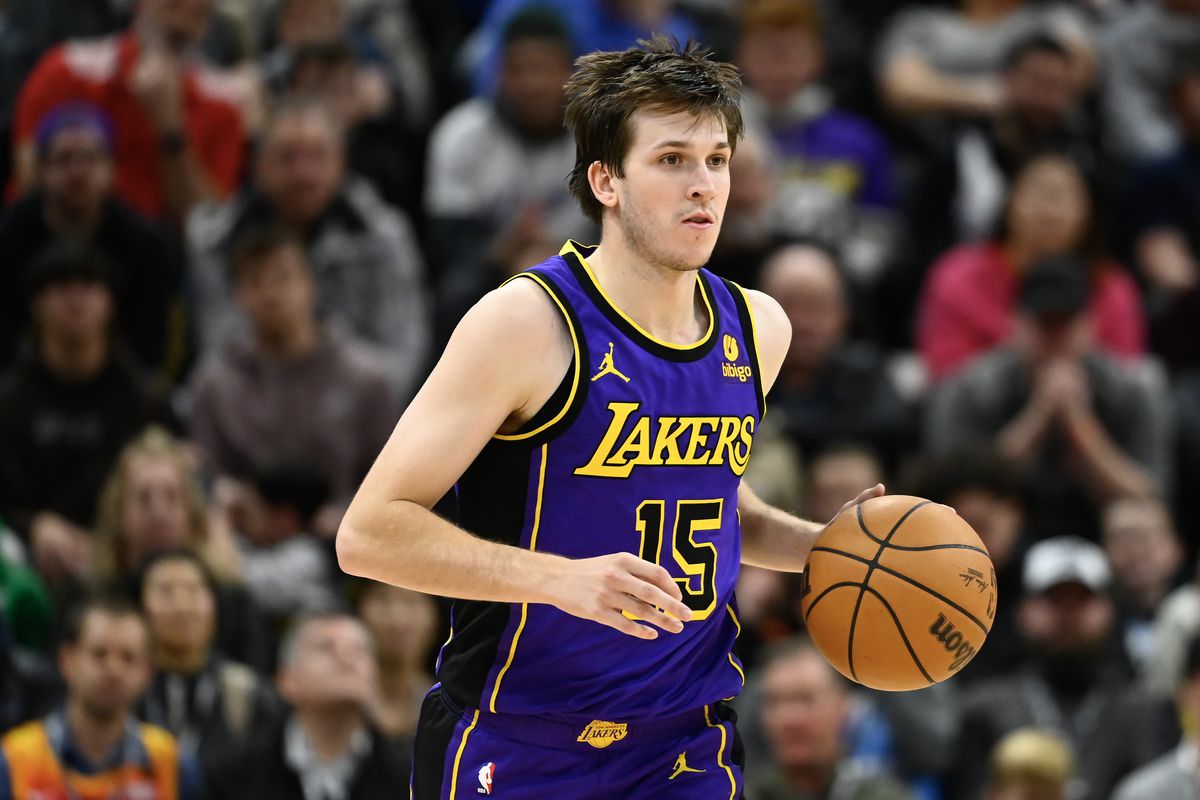
In the modern NBA, where “length and speed” are treated as the only currencies that matter, Austin Reaves is a glitch in the physical matrix. He is a 165-pound guard from Newark, Arkansas—a town of 1,000 people—who has somehow transformed himself into a primary engine for the most storied franchise in basketball. To the casual observer, Reaves’ rise looks like a lucky break. To those who study the geometry of the game, it is a masterclass in psychological warfare and high-IQ spatial manipulation.
In a landmark sit-down on the Mind the Game podcast, Reaves joined LeBron James and JJ Redick to deconstruct his improbable journey. What emerged wasn’t just a feel-good story of hard work, but a cold, calculated blueprint of how “delusional confidence” can bridge the gap between a small-town gym and the bright lights of Crypto.com Arena.
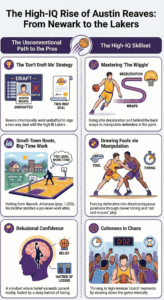
1. The Power of No: Why Reaves Orchestrated His Own Draft Fall
Most college players would sell their souls to hear their names called on draft night. Austin Reaves chose to go unheard. During the interview, Reaves detailed the “Detroit backstory”—a strategic gamble that serves as the ultimate litmus test for his self-belief.
Entering the 2021 NBA Draft, Reaves and his agent, Reggie, weren’t looking for the prestige of a second-round cap. They were looking for a “Tier One” fit. Using an analytics-driven approach, they identified the Lakers, the Bucks, and one other team as the only situations where Reaves’ high-IQ playmaking would be utilized rather than buried. When the Detroit Pistons called at pick 42, Reaves didn’t celebrate; he gave the instruction: “Don’t draft me.”
By bypassing the draft, Reaves secured the agency to sign a two-way deal with the Lakers, knowing their roster was thin on guaranteed contracts. It was a move that prioritized long-term career gravity over immediate status. As Reaves noted, it “sucked” to watch the draft pass him by, but the calculation was clear: he wasn’t just trying to get into the league; he was trying to stay there.
“It came down to sticking to a plan… and it sucked to not hear my name called. But obviously putting ourselves in a good position was much more important.”
2. The Architecture of Delusion: Survival as a Small-Town Underdog
Reaves’ hallmark is “delusional confidence,” but that fire wasn’t sparked by a trainer or a highlight reel—it was forged through the “tough love” of Newark, Arkansas. Competition was the family’s native tongue. His parents and his older brother, Spencer, never let him win. Whether it was cards, video games, or one-on-one, the young Reaves was forced to earn every inch of progress.
Spencer, who now plays professionally in Germany, acted as the primary architect of Austin’s work ethic. He would drag a reluctant Austin to the gym at 8:00 PM, essentially wearing him out to build his resilience. This environment fostered a psychological quirk: Reaves learned to hate losing more than he loved winning. This internal fire was tested when he told his father he was quitting baseball—the sport where he was a legitimate top-tier prospect—to focus on basketball, despite weighing a mere 95 pounds at the time.
This is the “delusional” part of the equation: the ability to ignore the “outside reality” of being a sub-100-pound kid in a town of a thousand people while telling your baseball coach that you’re going to be a pro hooper. When his coach told him basketball wouldn’t work out, Reaves simply replied: “Well, we’ll see.”
3. The LeBron Scouting Report: Identifying the “Wiggle”
LeBron James is notoriously selective about his basketball peers. Before Reaves ever stepped onto a Lakers practice floor, James had already scouted him through his Wichita State and Oklahoma highlights. LeBron’s assessment was immediate and culturally nuanced: Reaves “didn’t play like a white boy.”
Coming from Northeast Ohio, LeBron explained that he knows the difference between “white guys playing like white guys” and “white guys playing like the brothers.” What he saw in Reaves was a unique “wiggle”—a shifty, fluid rhythm that allowed him to crack the seams of a defense. It was a pro-level game hidden in a unassuming frame.
LeBron recognized that Reaves’ high IQ acted as a physical equalizer. Because Reaves lacks a 40-inch vertical, he compensates by thinking the game two steps ahead, manipulating defenders into the “funnel” of the defense. This mental processing convinced LeBron to “push belief” into the rookie from day one, forcing confidence into him before Reaves even realized he belonged.
“I kind of made it a point to kind of beeline it to him and kind of force something into him… Push that belief and that confidence like, ‘You belong here.'” — LeBron James
4. Technical Improvisation: The “Get Out of Jail” Wrap
One of the most technical revelations from the interview involved Reaves’ signature “behind-the-back” wrap. To Reaves, this isn’t a flashy crossover; it’s a strategic “get out of jail” card used to reset an attack or accelerate through a closing window.
Assistant coach Phil Handy has compared Reaves’ ability to change direction to that of Kyrie Irving. Specifically, Reaves possesses the rare ability to change his momentum on one foot without a perfect base. Unlike most players who must decelerate to go behind the back, Reaves maintains his speed, making him a scouting report nightmare.
A prime example is his “wrong-leg floater” against Rudy Gobert. By attacking the 7’2″ Defensive Player of the Year with unexpected timing and off-beat footwork, Reaves turns Gobert’s size against him. Because Reaves doesn’t pre-determine his moves, he simply reacts to the defender’s hips. If a defender like Gobert bites on a hang-dribble, the “wrap” allows Reaves to accelerate into the space the defender just vacated.
5. The Art of the Foul: Psychological Warfare in the Paint
The “foul merchant” narrative often follows Reaves, but a technical breakdown reveals it as a byproduct of elite rim pressure. Reaves utilizes a “low pickup” on his drives, intentionally keeping the ball in a zone where defenders are biologically wired to reach.
By baiting the defender’s hands low, Reaves creates a psychological dilemma: reach and foul, or back off and concede the space. Much like Luka Dončić, Reaves dictates the officiating by making the defender feel unsafe in their own cylinder. When he bumps a defender mid-stride—specifically when their lead foot is in the air—he effectively “takes their legs out,” forcing them off-balance and opening the funnel for a lob to Anthony Davis or a skip pass to the corner.
This isn’t just baiting; it’s manipulation. Reaves lets the defensive scheme tell him what to do. If the defender opens their hips to avoid the foul, he attacks the gap. If they stay tight, he uses the contact to create the very gravity that collapses the defense.
Topic | Key Details | Mentioned Persons | Associated Location | Inferred Significance | |
|---|---|---|---|---|---|
Draft Strategy | Reaves and his agents (including Reggie) executed a “Don’t draft me” plan to bypass being selected at number 42. They aimed for a specific two-way contract opening with the Lakers to ensure a better developmental path. | Austin Reaves, Reggie | Detroit, Los Angeles | Prioritizing organizational fit and a clear path to a roster spot over the prestige of being a second-round draft pick. | |
Early Lakers Experience | LeBron James instilled confidence in Reaves from the beginning, having recognized his “wiggle” and professional-level playmaking from his college highlights. | LeBron James, Austin Reaves | Wichita State, Oklahoma, Los Angeles | Receiving validation from a superstar accelerated Reaves’ transition and solidified his belief that he belonged in the NBA. | |
Tactical Insight: Behind-the-Back Dribble | Reaves utilizes a signature behind-the-back move on one foot to change direction, reset plays, or create rim pressure while maintaining his acceleration. | Austin Reaves, Phil Handy, Kyrie Irving, JJ Redick | NBA Court | A mechanical advantage that allows Reaves to manipulate defenders and create advantages despite not being a top-tier explosive athlete. | |
Tactical Insight: Foul Drawing | Reaves employs low pickups and shot fakes to dictate official calls. He views drawing fouls as an “art” used to force defenders to back off and maintain offensive efficiency. | Austin Reaves, Luka Doncic | NBA Court | Strategic use of the rulebook to create space and psychological pressure on the defense. | |
Clutch Mentality | Reaves emphasizes the importance of staying calm during chaos and wanting the ball in high-tension moments, specifically citing his rookie-year game-winner in Dallas. | Austin Reaves, Russell Westbrook | Dallas | The ability to “slow the game down” during high-pressure situations establishes him as a reliable closing option for the team. | |
Confidence and IQ | Reaves attributes his professional success to a “delusional confidence” and a high basketball IQ, which he uses to negate the physical disadvantages he faces on the court. | Austin Reaves, Anthony Davis, Rajon Rondo | Newark, Arkansas | Mental fortitude and strategic thinking serve as equalizing forces against opponents with superior raw athleticism. | |
Family Influence | His brother Spencer was a foundational influence, dragging him to the gym in their small hometown and instilling a professional work ethic through sibling rivalry. | Spencer Reaves, Austin Reaves | Newark, Arkansas; Germany | Sibling mentorship and a rigorous work ethic were essential for transitioning from a town of 1,000 people to the global stage of the NBA. | |
College Career and Recruiting | Reaves played for Wichita State and the University of Oklahoma; coaches and scouts initially doubted him due to his thin frame and lack of perceived athleticism. | Lon Kruger, Austin Reaves | Wichita State, University of Oklahoma | Proving his value by overcoming the “eye test” and physical skepticism through skill development and on-court performance. |
The Blueprint for the Modern Veteran
Austin Reaves’ meteoric rise was perhaps best summarized by a single viral coaching moment with LeBron James. After LeBron posted a clip of the two on social media, Reaves’ following exploded from 60,000 to 7 million. But the fame is secondary to the “Austin Reaves Blueprint.”
Reaves has proven that at the highest level of basketball, the ability to process the game’s geometry is just as explosive as raw athleticism. He wasn’t just a “walk-on” success story; he was a strategic thinker who understood that “IQ and Work” could consistently dismantle “Length and Speed.” As teams increasingly look for high-efficiency, low-cost veterans who can plug-and-play alongside superstars, the Reaves model of skipping the draft for a Tier One fit might just become the new standard for the college veteran. In a league of giants, the “delusional” kid from Arkansas found a way to make the giants play at his pace.

Sam, a dedicated blogger, has immersed himself in the world of content creation for the past five years. His journey reflects a profound passion for storytelling and insightful commentary. Beyond the digital realm, Sam is a devoted NBA enthusiast, seamlessly blending his love for sports with his writing pursuits.