
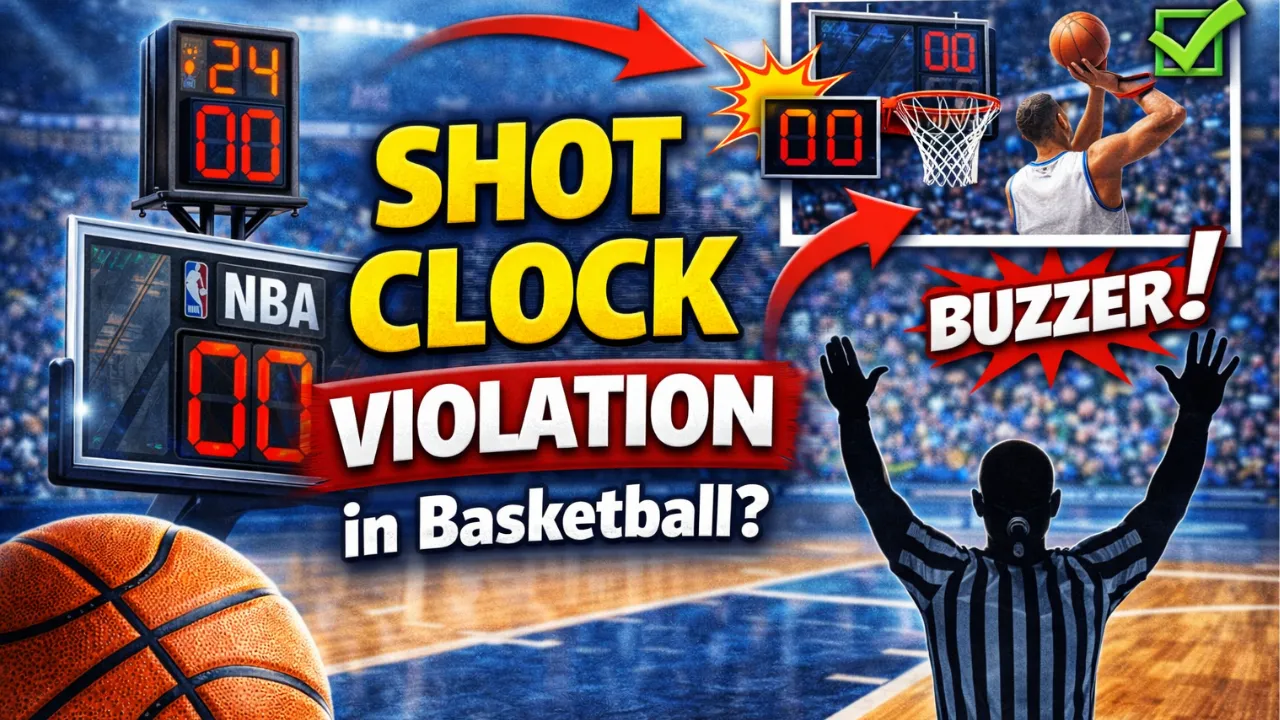
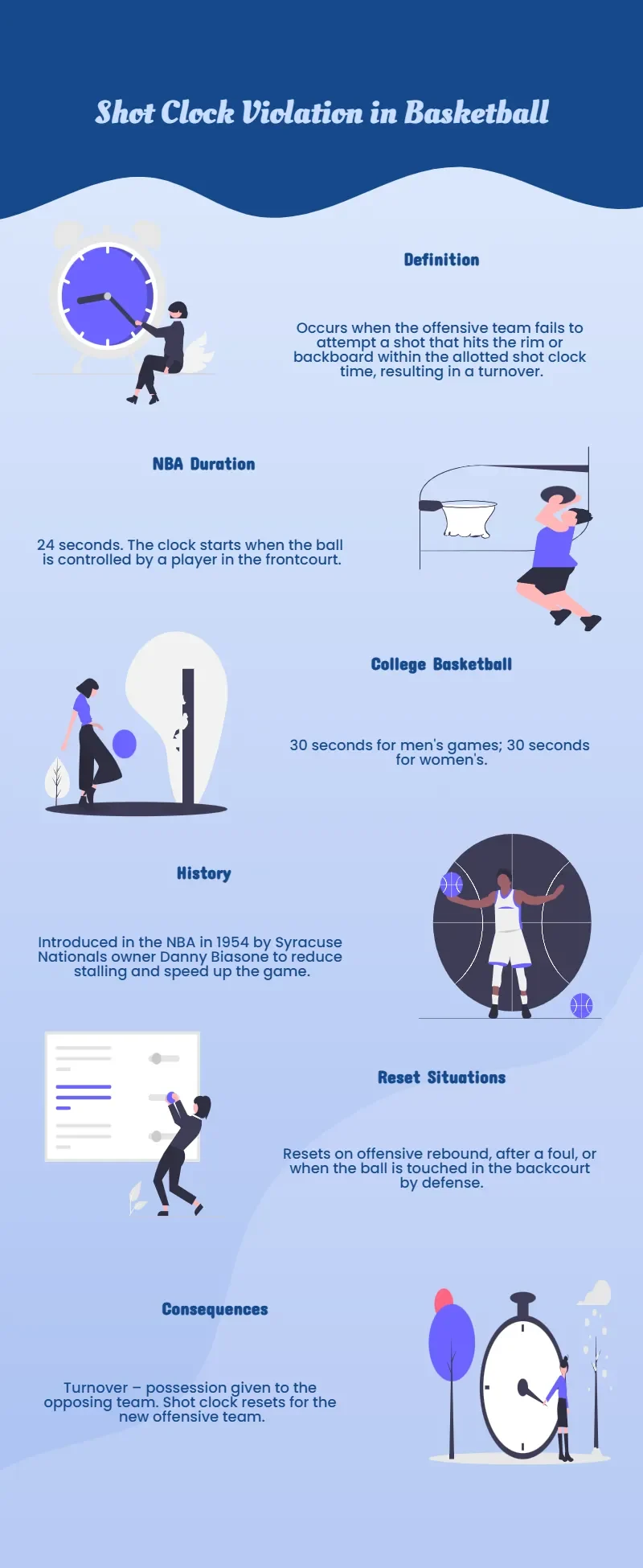
A shot clock violation in basketball happens when the offense fails to attempt a field goal within the required time limit—usually 24 seconds in the NBA—resulting in a turnover to the other team. It’s the ref’s buzzer signaling “time’s up” on stalling, keeping games fast and fair.
What Is a Shot Clock?
Think of the shot clock as basketball’s built-in hurry-up button—a visible timer showing how long your team can hold the ball before shooting. It starts counting once you gain possession (like after a rebound or inbound pass) and resets on made shots, rim touches, or turnovers. No shot attempt before zero? Violation city—ball to the defense. Introduced to kill boring stall-fests, it forces action and ups scoring.
Shot Clock for NBA
NBA runs a strict 24-second clock, displayed courtside with tenths shown under 5 seconds. Starts on legal touch during inbounds or new possession. Resets to full 24 on:
Change of possession.
Offensive rebound after rim touch.
Fouls sending ball to backcourt.
Drops to 14 seconds after defensive fouls or three-second violations. Endgame tweak: under 24 seconds left in quarter, it pauses on changes till timeout or score. Pros like Curry thrive under pressure; rookies panic and brick.
College Basketball Shot Clock (NCAA)
NCAA uses 30 seconds for men’s and women’s D1—longer breath for set plays. High school varies (30-35 seconds where adopted, optional per state). Starts same way: touch on court or control after jump ball. Resets on rim hits or scores; violation if no shot leaves hand by zero. Women’s college went 30 from 25 in 2015 for parity. March Madness chaos? Shot clock keeps underdogs shooting, not milking clock.
How Shot Clock Violations Happen
Common culprits:
Stalling: Half-court passes eating time without attack.
Bad shot clock management: Pass around perimeter, forget to shoot.
Turnovers near expiry: Steal with 2 seconds left? New 24 for defense-now-offense.
Ref signals by arm circle and whistle; buzzer blares. Even if shot leaves hand at :00.1 and swishes, it counts—no violation. Defensive touch without control? Clock keeps running.
Key Rules and Resets
Universal across leagues:
Starts: Player touches ball in play.
Stops: Timeouts, fouls, violations.
Resets fully (24/30): New possession, backcourt inbound.
Partial (14 sec NBA): Frontcourt foul, kicked ball.
Edge case: Ball goes out after offense last touch? Their clock continues. No shot clock in final 14 seconds of period if under that time left (NBA).
Why It Matters for the Game
Pre-shot clock (before 1954 NBA), teams stalled leads—yawn-fests with 60-point games. Danny Biasone timed 66 college games, set 24 seconds: boom, scoring jumped 14 points per game. Today, it paces modern NBA (100+ points routine) and preps kids for pros. AAU/youth leagues adopt it for better habits—faster ball movement, smarter shots.
Differences Across Levels
| League | Shot Clock | Key Notes |
|---|---|---|
| NBA | 24 seconds | Strictest, 14-sec resets common . |
| NCAA Men/Women | 30 seconds | More half-court sets . |
| FIBA/International | 24/14 seconds | Dual clock like NBA . |
| High School (optional) | 30-35 seconds | Builds pace gradually . |
| WNBA | 24 seconds | Matches NBA flow. |
Pro Tips to Avoid Violations
Call out “shot!” at 10 seconds.
Train quick decisions—pass or shoot.
Use motion offense: screens, cuts.
Apps track practice clocks for AAU squads.
From Meerut gyms to NBA arenas, mastering this keeps you in rhythm—violate often, and you’re chasing the game.
Shot clock violations aren’t just penalties; they’re the pulse pushing basketball’s non-stop thrill. Nail the rules, and watch games flow like poetry.

Sam, a dedicated blogger, has immersed himself in the world of content creation for the past five years. His journey reflects a profound passion for storytelling and insightful commentary. Beyond the digital realm, Sam is a devoted NBA enthusiast, seamlessly blending his love for sports with his writing pursuits.